Sainte-Eponime mummy collection
Journey to the End of the NightThe Sainte-Eponime mummy collection is a group of preserved human remains exhibited for paying visitors in a crypt beneath the Church of Sainte-Eponime in Toulouse. Its importance lies in the double life the novel gives the mummies: they are evidence of physical decay and objects of public curiosity, but also the basis of a working business whose income is disputed among Grandma Henrouille, Robinson, and the church’s priest.
Location and Collection
When Ferdinand Bardamu visits, the crypt lies beneath a small garden near a calvary, and its entrance is a barricaded opening. The collection consists of twenty-six bodies, large and small, preserved after more than five hundred years in quicklime. It includes two women still wearing bonnets, a hunchback, a giant, and a complete infant with remnants of a bib and swaddling clothes. The bodies are no longer intact in any ordinary sense: the display presents remains in which skin, clothing, and bones persist in fragments, while time continues to break them down.
Bardamu encounters the collection in lantern light with Madelon, who explains how the bodies were preserved and describes the different figures among them. The arrangement makes the crypt at once a tourist attraction and a confrontation with mortality. Visitors are invited to inspect the remains as an unusual sight; the narration, however, stresses the long process by which bodies have approached dust and the physical persistence of decay. The mummies’ silence also matters: their appearance can be presented to visitors as reassuring or amusing, but the dead cannot confirm the stories told about them.
The Exhibition as a Business
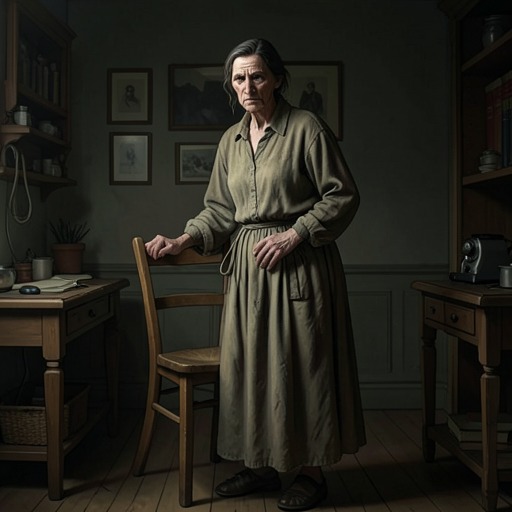
Grandma Henrouille runs the crypt as a source of income. At the height of summer, when tourist parties arrive, the business brings her a hundred francs a day. She meets visitors in the cellar and delivers an explanatory sales pitch about the remains: their preservation in quicklime, their age, their state of preservation, and the features that make individual bodies memorable. She invites visitors to give what they like, while identifying two francs per person as the usual payment and half that amount for children. She also permits visitors to touch the mummies, warning them not to pull too hard because the remains are fragile.
Her performance turns the collection into more than a static display. She animates the tour with jokes and demonstrations, including striking the remains to produce a drumlike sound. The comedy is part of the attraction’s commercial operation, and the bodies are made to serve as performers even though they cannot consent or speak. Bardamu contrasts the tourists’ easy response to the dead with his own knowledge that dying is painful; the collection’s public presentation therefore exposes the distance between death as a paid spectacle and death as an experience.
Labor, Profit, and Dispute
The income from the collection is divided uneasily. Grandma Henrouille has sought permission from the Diocese to raise the prices, but the arrangement is complicated by the priest at Sainte-Eponime, who claims a third of the proceeds. Robinson, who helps with the business, also complains that his share is too small. From his position at the crypt door, he addresses tourists and gradually becomes accustomed to making out points of light, while Grandma Henrouille handles the deeper work of conducting the tours among the mummies.
The arrangement had first been proposed to Robinson and Grandma Henrouille as a way to earn money from the remains. Abbé Protiste presents it as a profitable business, and Bardamu accepts the proposal in part because it promises a commission. The plan makes the dead into a source of income for the living, with a priest, a caretaker, and Robinson all participating in or claiming a share of the proceeds. Its practical success does not resolve the question of fairness: Robinson feels cheated, while Bardamu argues that Robinson contributed no money to establish the enterprise and is already fed and cared for.
Significance in the Novel
The mummies connect the novel’s recurring attention to bodily decay with its unsentimental account of economic survival. Grandma Henrouille, who once seemed physically near the condition of the remains, now earns her living by displaying them. The crypt makes that reversal concrete: the dead are not removed from ordinary economic life but incorporated into it, their preservation and display organized around admission fees, commissions, and arguments over the take.
The collection also complicates the boundary between sacred space and commerce. Its location beneath a church and the priest’s claim to a third of the income do not prevent the crypt from operating as a tourist business. Instead, religious jurisdiction and commercial interests share the same attraction. By making the mummies both objects of morbid curiosity and the means of supporting their keepers, the novel turns the crypt into a concentrated image of a world where even death can be made to work.